Go here: http://donleyscience.weebly.com/
and directly to the forum here: http://donleyscience.weebly.com/moeducation
Wednesday, December 14, 2016

Wednesday, July 22, 2015
Global MindEd Conference Thoughts...
The Global MindEd conference this past June was an inspiring event. What made it inspiring is that there were very few K-12 educators in attendance compared to business, entrepreneurs and higher education folks. This reminded me that there are many people out there that care about education and the world, and that they want to make a difference for pre-K to college students!
I had the wonderful opportunity to present in the IDEA cafe with Jessica Hatz of the Global Ozone Project. We presented on how we employed GO3’s black carbon and ozone detectors in the classroom. Students planned treks, collected data and posted the data over-layed on Google Earth. From there they could analyze their data on a social network. The students went even further by creating a website to teach others about sustainability and climate issues. This project inspired others attending the conference, and it fostered classroom connections that will be in place for the coming year.
Most importantly, the conference reminded me that providing a quality education for all students is our most pressing global issue! With all of the reform measures of the past few years, it is time for the U.S. to reflect on what we know is best practice and on what has made us an innovative country! Educators, entrepreneurs, and businesses can work together to re-invigorate the spirit of creativity and innovation to provide relevance and rigor to our nation’s schools. It is through partnerships such as the global ozone project that Monarch High participated in that fosters this spirit of creativity and innovation, and extends the love of inquiry, design thinking and entrepreneurship to the participating students.
Global MindEd reminded me of this spirit. It reminded me that I am not alone in fighting for this spirit to be in the curriculum for all students, and it re-energized me to continue to do what is best for my students!
If you are interested in the Global Ozone Project, go to their website and apply to be a Global Treks school. Partnerships such as these are what your students will remember for years to come, so don’t be afraid to take a risk and try something new!
In closing, I would like to share the following is a quote from the Global Ozone Project newsletter:
“Jess, the GO3 Project's Outreach Coordinator, was given the opportunity to attend two innovative conferences this June focusing on education: GlobalMindED and the Colorado Education Initiative's 2015 Showcase. GlobalMindED took place in downtown Denver and connected like-minded people from the fields of education, industry, non-profits, entrepreneurship, and government to envision a future for education rooted in equity, access, and innovation. GO3 hosted an Idea table with science teacher Kristin Donley from Monarch High School and featured the GO3 Treks program and an awesome website on climate change and sustainability made by Mrs. Donley's students. Some of the conference highlights included keynote speaker Michele Weslander Quaid from Google and a panel led by entrepreneur Teju Ravilochan, CEO of the Unreasonable Institute.”
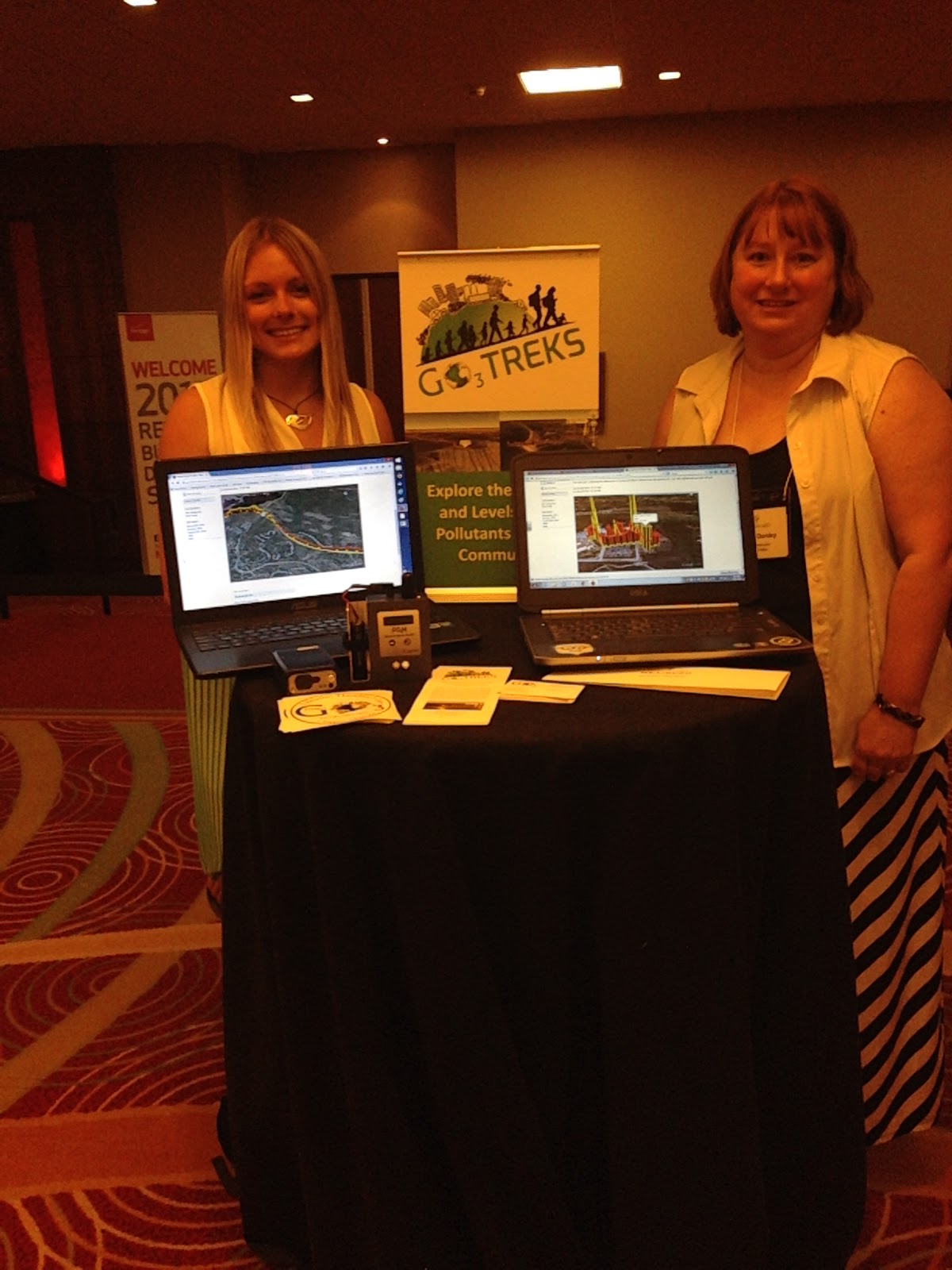 |
Jess & Kristin Hosting an Idea Table at GlobalMindED
|
Wednesday, June 10, 2015
3D Comes to School
classroom and 3D technology An article showcasing the 3D fundraiser and what we were able to purchase to help students understand abstract material in science and math better! Thanks to all of our wonderful parents and communitiy members for making this possible!
Friday, September 26, 2014
MoHi BYOD Website
I would like to share the link to Monarch High School's Bring Your Own Device website that I have been adding resources and information to over the past couple of years. Everything from our vision to helpful integration ideas can be found on this site! Feel free to join our forum and join the discussion about computer use!
MoHI BYOD
MoHI BYOD

Thursday, September 18, 2014
Using Technology to Collect and Analyze Data
;
There are many ways teachers can use technology in creative ways to promote inquiry. I recently joined the Global Ozone Project to measure local ozone and black carbon levels. We were loaned the equipment and sensors to take walking treks to measure data and then it was uploaded to the GO3 website. Students joined the site so they could blog about the data.
Here is a link to our first trek-- MHS Parking Lot Trek
This project brings relevance to the classroom by involving students in an actual ongoing experiment. They get the chance to collect data, analyze it using Google Earth 3D mapping software and blog about their hypotheses/preliminary conclusions. My students can see treks from all over the world and make global connections!
How are you using technology in a novel way to promote critical thinking skills?
Here is a link to our first trek-- MHS Parking Lot Trek
This project brings relevance to the classroom by involving students in an actual ongoing experiment. They get the chance to collect data, analyze it using Google Earth 3D mapping software and blog about their hypotheses/preliminary conclusions. My students can see treks from all over the world and make global connections!
How are you using technology in a novel way to promote critical thinking skills?
Sunday, January 5, 2014
Transforming the School
http://www.nytimes.com/roomfordebate/2010/12/12/stress-and-the-high-school-student/change-the-pace-of-the-school-day
BVSD schools have done all of the things mentioned in the above article, but I do not think it is enough. I feel that taking 7-8 classes is too many for students, especially since most of them are involved in sports or other after school activities. Students seem to mindlessly go from one class to another--always feeling behind and just "jumping through the hoops." There is no real incentive for learning! I call for a drastic change in the scheduling-- a transformation. I envision a school where students have large blocks of time to work on and understand the curriculum. Blocks that are integrated where students are applying mathematics, science, history and language and integrated arts together. For example, Colorado College (http://www.coloradocollege.edu/) is an example where students take one or two classes at a time, thereby focusing on one area. I envision a learning environment where students aren't busily running from one class to another, sitting listening to lecture after lecture-- I envision a place where bells are not necessary, students work together in larger multi-faceted areas with access to the latest technology and tools, where they can critically think and apply their knowledge in innovative and imaginative ways. I envision a place where service learning is an integral part of the curriculum and where educators connect students to opportunities.
I know this vision is not a panacea, but it is time we critically examine why we use the school schedules that we do? Life has changed drastically over the past 100+ years since public schooling has become the norm---why have we not (for the most part) changed our school schedules? Is there a better way? What is holding us back?
What are your thoughts?
BVSD schools have done all of the things mentioned in the above article, but I do not think it is enough. I feel that taking 7-8 classes is too many for students, especially since most of them are involved in sports or other after school activities. Students seem to mindlessly go from one class to another--always feeling behind and just "jumping through the hoops." There is no real incentive for learning! I call for a drastic change in the scheduling-- a transformation. I envision a school where students have large blocks of time to work on and understand the curriculum. Blocks that are integrated where students are applying mathematics, science, history and language and integrated arts together. For example, Colorado College (http://www.coloradocollege.edu/) is an example where students take one or two classes at a time, thereby focusing on one area. I envision a learning environment where students aren't busily running from one class to another, sitting listening to lecture after lecture-- I envision a place where bells are not necessary, students work together in larger multi-faceted areas with access to the latest technology and tools, where they can critically think and apply their knowledge in innovative and imaginative ways. I envision a place where service learning is an integral part of the curriculum and where educators connect students to opportunities.
I know this vision is not a panacea, but it is time we critically examine why we use the school schedules that we do? Life has changed drastically over the past 100+ years since public schooling has become the norm---why have we not (for the most part) changed our school schedules? Is there a better way? What is holding us back?
What are your thoughts?
Check out http://www.mister-nick.com
Saturday, November 30, 2013
Gamifying the classroon
I am in the process of Gamifying my classroom and found these resources helpful!
1. http://techsanityedu.blogspot.com/ Thank you Mr. Downing--- your advice is invaluable and you are an inspiration to great teaching and learning!
2. http://www.youtube.com/watch?v=rN0qRKjfX3s from Pennyarcade TV
http://www.penny-arcade.com/patv/episode/gamifying-education
3. http://www.youtube.com/watch?v=O2N-5maKZ9Q TEDEX talk- Gabe Zichermann
4. http://www.gamifyingeducation.org/ Gamifying education website
5. http://gamification.org/wiki/Gamification_of_Education Gamifying Wiki
6. http://www.esparklearning.com/gamification-of-education/ Espark-- why gamify?
So I am embarking on a pilot to gamify my classroom. I decided to do this because it seems that as the years go by in my teaching career, students are losing their incentive to turn work in on time. A student in my AP Biology class introduced me to the concept and wanted to do a pilot to see if it would help student engagement and motivation. I currently use a lot of technology in my classroom including Schoology, a learning management platform. The technology I have can easily be integrated into creating a classroom "Game" environment. I am starting small by creating "houses" for competition like in the Harry Potter movies. I will have a sorting hat to place students into groups ("Houses")-- which is part my decision and part the student's decision. Each house will come up with a name, colors and symbol. Students will compete for "badges" created in Schoology which represent their mastery of the content (i.e., standards). Points will be tallied along the way--through a leader board. This takes care of competition and collaboration.
Many of my assignments have a storyline-- I will just make sure to wrap them together and link to the earning of the badges. Hopefully this will encourage more PRIDE in their learning!
I will update you on my journey--- please feel free to make comments on this post if you have tried anything along these lines before or have ideas to share!
1. http://techsanityedu.blogspot.com/ Thank you Mr. Downing--- your advice is invaluable and you are an inspiration to great teaching and learning!
2. http://www.youtube.com/watch?v=rN0qRKjfX3s from Pennyarcade TV
http://www.penny-arcade.com/patv/episode/gamifying-education
3. http://www.youtube.com/watch?v=O2N-5maKZ9Q TEDEX talk- Gabe Zichermann
4. http://www.gamifyingeducation.org/ Gamifying education website
5. http://gamification.org/wiki/Gamification_of_Education Gamifying Wiki
6. http://www.esparklearning.com/gamification-of-education/ Espark-- why gamify?
So I am embarking on a pilot to gamify my classroom. I decided to do this because it seems that as the years go by in my teaching career, students are losing their incentive to turn work in on time. A student in my AP Biology class introduced me to the concept and wanted to do a pilot to see if it would help student engagement and motivation. I currently use a lot of technology in my classroom including Schoology, a learning management platform. The technology I have can easily be integrated into creating a classroom "Game" environment. I am starting small by creating "houses" for competition like in the Harry Potter movies. I will have a sorting hat to place students into groups ("Houses")-- which is part my decision and part the student's decision. Each house will come up with a name, colors and symbol. Students will compete for "badges" created in Schoology which represent their mastery of the content (i.e., standards). Points will be tallied along the way--through a leader board. This takes care of competition and collaboration.
Many of my assignments have a storyline-- I will just make sure to wrap them together and link to the earning of the badges. Hopefully this will encourage more PRIDE in their learning!
I will update you on my journey--- please feel free to make comments on this post if you have tried anything along these lines before or have ideas to share!
Thursday, November 28, 2013
50 Tech Resources for Educators
http://www.edudemic.com/50-education-technology-tools-every-teacher-should-know-about/
Saw Tammy at ISTE-- great website full of resources!
http://www.tammyworcester.com/Tips/Tammys_Technology_Tips_for_Teachers.html
Saturday, November 2, 2013
100 Best Science Videos on You-Tube!
100 Best YouTube Videos for Science Teachers (From Teaching Community)
Warning: links below may change as the Internet changes.
By now, YouTube’s value in the classroom should be rather self-evident. No matter the subject or grade level, the website offers up excellent videos to supplement lessons and provide windows into different facts and concepts. Science teachers especially have plenty to love and appreciate with this valuable resource. Everything from microbiology to astrophysics makes an appearance through a channel operated by a museum, university, educator, professional or interested individual. Because so many of the sciences require visual aids to really open up and explain their very cores and valuable applications.
It should be noted that this list does not contain any Mythbusters videos, as I lack any semblance of self-control and would just end up listing 100 of them instead of providing a diverse selection to meet the needs of different classrooms. Rest assured, though, that there is probably a clip from Mythbustersavailable to fit almost any lecture.
1.) They Might Be Giants: “Meet the Elements” (BB Video)
Boing Boing presents the single greatest animated science video on YouTube, accompanied by a catchy song about the periodic table – courtesy of the venerable They Might Be Giants.
 2.) Diet Coke + Mentos
If allowing the little nose-mining cherubs to conduct their own Diet Coke and Mentos experiments means injuries and lawsuits, then showing them the video that launched the craze will probably work as a reasonable substitute.
3.) The Science of Caddyshack
Believe it or not, the movie Caddyshack actually involves real-life science – as the Discovery Channel’s James Williams is more than eager to share.
4.) The Inner Life of the Cell
Biology teachers hoping for a wonderful visualization of cellular functioning and structure absolutely need to show off this gorgeous animated collaboration between Harvard and XVIVO. The fact that it does not involve any audio beyond some wonderfully soothing music means it can serve as a nice backdrop to a lecture.

5.) They Might Be Giants – How Many Planets?
Anyone who doesn’t wax nostalgic over the loss of dearly beloved Pluto (1930-2006. Never Forget.) probably kicks orphaned, widowed puppies in his or her spare time.
6.) Turtle Takes on a Shark
All the cheesy fun of a SyFy original movie, with the added bonus of being both real and educational!
7.) 2010 Exploring Space Lecture: Where the Hot Stuff Is: Volcanoes of the Earth and Solar System
At over 1 hour in length, this lecture on volcanism beyond the familiar structures on Earth is best presented in bits and pieces that dovetail nicely with lessons.
8.) Pistol Shrimp
Spice up a biology or ecology class with a crazy awesome video of a shrimp capable of shooting jets of water almost as hot as the surface of the sun!
9.) Killing Anthrax Faster and Greener
Killing off hearty anthrax usually eats up insane amounts of time and involves corrosive components, but a new method may prove more efficient and ecologically-friendly.

10.) “New World” Asteroid Photographed
21 Lutetia, so far, is the largest asteroid any human has yet to see up close. This amazing footage, courtesy of National Geographic and the European Space Agency, makes for a great addition to any astronomy class.
11.) They Might Be Giants – Roy G Biv
Off their “Here Comes Science” album – which, incidentally, will crop up on this list multiple times – comes a nifty little ditty about the color spectrum. Of course, it comes with a fun animated music video of its own.

12.) Edible Insects
Cultures all over the world rely on insects to provide protein and other nutrients, and the staff at the National Museum of Natural History share their thoughts on trying a food considered “gross” in Western society.
13.) Giant Double Rainbow
Discovery News sheds some light on a YouTube video involving an anomalous double rainbow, offering a cool, quick lesson in refraction and spectrum physics.
14.) Mirage 1
Robert Krampf is pretty much the Bob Ross of science, and this warm, accessible video explains the basics of how mirages work.
15.) They Might Be Giants - Speed and Velocity w/ Marty Beller
The Flash has nothing on these 2 enjoyable superheroes, who introduce lessons in the difference between speed and velocity.
16.) Earth-Building Wounds
Scientists are studying the unique geological properties of Iceland in order to better understand how tectonic plates form and shift to permanently change the shape of the planet.
17.) The Wright Brothers Discover Aspect Ratio
John D. Anderson at the National Air and Space Museum provides an interesting talk on the Wright Brothers and their indispensible contributions to the history of human flight.
18.) Through the Wormhole: DNA
Morgan Freeman(!!!!!!) narrates a brief clip on the structure and importance of DNA. Short, but soothing. Also educational. Also Morgan Freeman.

19.) Extraordinary Gorilla Encounter Explained
Learn about the reality behind Damian Aspinall’s re-introduction to a gorilla he raised 5 years prior – an interesting glimpse into primate behavior!
20.) Microwaving the World
More sensitive classes may not like thinking about the negative impact an aging sun would have on the planet, but this video still has plenty to offer science teachers whose lessons involve the lifecycles of stars.
21.) Electric Car – They Might Be Giants w/ Robin Goldwasser
Students learning about ecology and alternative energy may appreciate another wonderful installment in They Might Be Giants’s “Here Comes Science” song and video series!
22.) What Do Visitors Really Know About Evolution?
This 1-hour lecture from the National Museum of Natural History shares some of the institution’s findings
regarding how to best educate visitors on the Theory of Evolution.

23.) Robot Controlled by Human Brainwaves
AAAAAAAAAAAAAAAAAAAAAAHHHHHHHHHHHHHHHHH!!!!!!!!!!!
24.) A Color You Can’t See
The infinitely huggable Robert Krampf explains that some colors exist outside of human perception, but cell phone cameras can help individuals see them in action.
25.) They Might Be Giants – Why Does the Sun Shine? (The Sun is a Mass of Incandescent Gas)
One of They Might Be Giants’s most famous songs just happens to have an application in the science classroom, particularly those involving astronomy.
26.) The Medical Heroin Experiment
Educators who enjoy facilitating civil debates in their science classrooms may like this National Geographic video on the medical heroin controversy as a conversation starter.
27.) NASA Android Testing
In the 1960’s, NASA experimented with android robotics for possible space suit applications. They donated their footage (and the metal man himself) to the National Air and Space Museum to educate the populace on their findings.
28.) What is Synthetic Genomics?
Receive a crash course in how cells work and the field of synthetic genomics that has sprung up around them.
29.) Why is the Sky Blue?
Such a simple question actually has an interesting, complex answer involving spectrum physics!
30.) Big Cats Wild for Calvin Klein Cologne?
This humorous video showcases some very unusually findings by the Wildlife Conservation Society regarding how cheetahs react to Calvin Klein’s “Obsession for Men.”
31.) King Weed – They Might Be Giants
Throw a couple of suited men into a biology class for a neat musical discussion of evolution and survival of the fittest.
32.) Smithsonian geologist puts Eyjafjallajökull eruption in perspective
Energetic geologist Liz Cottrell analyzes a particularly infamous volcanic eruption and illustrates what it means for the planet’s structure.
33.) Ticks: Bloodsucking Ninjas of Summer
This useful video talks ticks, both their biology, the diseases they carry and how to prevent a negative encounter with these little Nasty Nellies.
34.) Making Butter
One of the first science experiments most children undertake in their educations involves turning cream into butter, deliciously illustrating different states of matter.
35.) They Might Be Giants – Computer Assisted Design
Listen to a neat song and watch a great animation on what technology can do to help mankind channel its creativity and solve serious problems.
36.) Amazing Northern Lights
Marvel at one of the most breathtaking meteorological occurrences, where lights in every color of the rainbow dance across the sky in smooth, elegant waves.
37.) Apollo 11 TV Broadcast – Neil Armstrong First Step on Moon
Watch one of the most triumphant moments in human history as Neil Armstrong becomes the first man to set foot on Earth’s moon.
38.) Sci Fi Science: Traveling at Warp Speed
Believe it or not, 1 mathematical equation may unlock the reality behind the currently fictitious concept of traveling through space and time without violating any known laws of physics.
39.) Cuttlefish: Chameleons of the Sea
The intelligent, gentle cuttlefish possesses the amazing ability to change both its color and its texture to fit the environment in which it feeds.
40.) Electromagnetic Sun Storms
Although the likelihood of such a deadly cavalcade of electromagnetism is minimal, the sun still holds the potential to wipe out human infrastructure with a particularly heavy burst.
41.) Photosynthesis – They Might Be Giants
Introduce classes to the fundamentals of photosynthesis with another delightful video by They Might Be Giants.
42.) Recreating Volcanoes in a Lab
Follow Liz Cottrell as she shows off the equipment she uses to study volcanoes without ever even leaving her lab.
43.) Sea Otter Poop May Help Save Species
Perfect for ecology and biology classes, this hopeful little video full of spunky l’il otters, information on nurturing their population growth and – of course – plenty of doo-doo.
44.) The Science of Balance
Robert Krampf talks about the relationship between gravity and balance, with plenty of simple, effective demonstrations to prove his point.
45.) I Am a Paleontologist – They Might Be Giants w/Danny Weinkauf
This video wraps up 3 things kids love into one catchy package – dinosaurs, music and not having to stare slack-jawed and disengaged during a lecture.

46.) Dropping 2 Million Pounds
Human engineering and construction has evolved to the point it can pick up a bridge weighing 2 million pounds and (very carefully!) haul it to a new location.
47.) Primordial Soup With Julia Child
The amazing, incomparable Julia Child lends her cooking skills to science education, mixing up a hearty brew of amino acids and discussing how integral they are to all life on Earth.
48.) Popular Science’s Future Of: Pleasure
One fun, enjoyable little robot has been programmed to improvise music and work with humans to improve their talents together and create some amazing songs.
49.) Smart Tech Measures Personal Water Consumption
Hydrosense, developed by the University of Washington, allows individuals to track how much water they use in a day – a useful little device for the ecologically-minded! Perhaps the ecologically-minded classroom?
50.) Twin Super Powers
The Hogans, a pair of twins joined at the cranium, possess an amazing cognitive and sensory ability to see and understand stimuli simultaneously – even if only one of the kids actually sees it.
51.) Solid Liquid Gas – They Might Be Giants
Another rocking time with They Might Be Giants, teaching kids the 3 basic forms of matter and how materials transition between them.
52.) Skeletal Growth- Smithsonian National Museum of Natural History in Washington, D.C.
Watch a brief animated video on how the magnificent human skeleton gradually grows from only 1 day old into adulthood.
53.) Star Spits Out Baby Planet
Punch up on astronomy lessons by showing a Discovery News video explaining – in layman’s terms – how debris from a star gradually creates planets.
54.) Static Charges
Experiment with static electricity alongside the lovely Robert Krampf and learn a few lessons about induction along the way.
55.) Brink – Space Junk
Internet celebrities Rhett & Link sing a catchy song about the manmade clutter that floats about the Earth’s orbit.
56.) Monsters of the Deep
The hugest bivalves in existence, the giant clams sit gently on the seafloor and continue to fascinate scientists for reasons other than their generous size.
57.) Let’s Go For A Spin: Lunar Rovers of Apollo and Constellation
Listen to a fascinating lecture on the latest developments in rover technology and the machinery’s importance to advancing humanity’s knowledge of outer space.
58.) The Nerdabout vlog – How to Hack a Wii Remote
Micro-controllers such as the Wii remote provide some very cool, very basic computing lessons.
59.) Is It Possible? Real Life Batman
Daniel Kish has been blind since the age of 13 months, but gets around almost as well as those with sight using flash sonar and echolocation. Really more of a Daredevil than a Batman, he “sees” with his ears by sending out clicks and measuring their echoes in order to form a “picture” of his surroundings.
60.) Dream Car Archaeology
Engineering classrooms – most especially those populated by gearheads – can find both entertainment and education in this cool National Geographic video of a restoration team working on a ’54 Oldsmobile. Considering the vehicle’s age, they have to piece together different clues and use logic and experimentation to find out what will and will not work.
61.) What Is a Shooting Star? – They Might Be Giants
Astronomy students sometimes struggle with the difference between meteors and meteorites, but enough rounds of They Might Be Giants’s catchy vocabulary lesson can set them straight.
62.) Coral Reefs – A Delicate Balance of Life at the National Museum of Natural History
This video offering by NMNH provides educators with some dramatic images of its coral reef exhibit, and the lack of narration makes it a nice backdrop for lectures on ocean life.
63.) Hawaii Volcano Shows Technicolor Lava
One of the most fascinating geological phenomena on the planet comes to life through infrared imaging, and Discovery News uses the available footage to discuss how scientists use the information to predict eruptions.
64.) Feathers
Explore the ins and outs of fabulous feathers, which contain a multitude of marvels beneath their simple surfaces.
65.) Mammals Vs. Dinos- Mammalian Sensory Development
Learn about the ways in which nocturnal behavior contributed to the perpetuation and evolution of different mammalian species.
66.) Nuclear Explosion in the Sky
Contrary to what many believe, explosives do not have to be dropped on a city in order to disrupt life and dismantle infrastructures.
67.) How Things Fly Exhibition – Blended Wing Body
Take a quick peek into NASA’s experiments in blended wing aircraft and learn a little bit about how they may end up increasing the efficiency of aeronautic vehicles.
68.) Visions of the Future: Intelligent Driving
“Computer power doubles every 18 months,” states this video by the Science Channel. Already, scientists are in a place conducive to designing and testing cars capable of driving themselves!
69.) SDO Captures Eruptions on the Sun
Witness dramatic solar activity recorded by SDO and learn about how the surface of the sun constantly changes.
70.) Slicing Up the Bay Bridge
Physics and engineering students curious about the real-world applications of their lessons may appreciate learning about the challenging repairs that construction workers faced when making the Bay Bridge safer.
71.) They Might Be Giants – Cells
As if the band hasn’t already provided a bevy of great songs and videos for science teachers, They Might Be Giants chimes in with a useful lesson on cellular fundamentals.
72.) Lessons from the Panama Oil Spill
Learn what Dr. Jeremy Jackson at the Scripps Center for Oceanography has to say about how humanity should react to horrifying oil spills based on past experiences.
73.) Why is it So Hard to Lose Weight?
This incredibly valuable video discusses biology, evolution, nutrition and anatomy while also teaching the healthiest method of losing weight.
74.) Solar Power
Solar power plants who use mirrors to capture energy provide some great lessons in how light reflection and refraction work.
75.) It’s All Geek to Me – Vinyl to Digital
David Pogue for the New York Times demonstrates how recording studios transfer music from old vinyl albums to digital media so as not to lose any classics.
76.) Extraordinary Adaptation
Dystonia causes sufferers to perpetually flex up to 500 muscles at once, and Jason Dunn opens up about what life is like with “one of the most annoying things you can imagine.”
77.) Apollo and the So-Called Moon-Landing Hoax
National Air and Space Museum’s curator of Space History Dr. Roger Launius dispels some of the conspiracy theories behind the first moon landing.
78.) Space School- Earth
Thus far, Earth has proven one of the most unique planets in the universe…and definitely the Solar System! Learn about the special properties it possesses that allows life to teem on its surface.
79.) Chimps Face Death Like Humans Do
Several studies have conducted research on how chimpanzees deal with the death of their friends and relatives, and the revelations have come as something of a shock.
80.) Why Geography Matters by Google Earth
Geography encompasses a wide array of subjects, and kids participating in the 2010 National Geographic Bee explain why they believe it’s so important to study.
81.) My Brother the Ape – They Might Be Giants
Teachers allowed to discuss evolution in their classrooms can play this They Might Be Giants video to illustrate the interconnectivity of different animals – including humans!
82.) Science with an Artistic Flair at the Smithsonian’s National Museum of Natural History
Enjoy some of the impressive portfolios from NMNH’s scientific illustrators, who merge the technical with the creative on a daily basis. To incredible results, no less!
83.) Stressed Veggies Better For You
Learn about the biological phenomena that cause cut vegetables to yield greater nutrients – useful lessons for a couple of different scientific disciplines!

84.) Pictures in Silver
The dying art of film photography seamlessly blends art with chemistry, and Robert Krampf shares a characteristically chill experiment explaining how the process works.
85.) The Physics of Baseball – Pitching
America’s allegedly favorite pastime possesses myriad opportunities for teachers to illustrate some of the basic principles of physics.
86.) Alpaca Fleece to Help in Gulf Oil Spill?
Ecology, geography, geology and biology converge in this interesting glimpse at how 4 alpacas at the Alabama Gulf Coast Zoo are contributing to cleaning up the 2010 BP oil spill – a handy lesson that transcends time and date.
87.) Big Blue Sky: The History of Hang Gliding
Physics and engineering classes may enjoy hearing some parts of Bill Liscomb’s neat lecture on the history of hang gliding.
88.) Beyond Tomorrow- Mercedes Brakes
The sleek, sexy Mercedes possesses some advanced technology capable of helping drivers use their breaks more efficiently and safely.
89.) LHC Collides at Record Speeds
CERN’s undeniably ambitious Large Hadron Collider may change the face of particle physics and its associated fields forever, and Discovery Channel provides a quick overview of what scientists hope it will accomplish.
90.) Frog Jumps Caught in Slow Motion
Watch some amazing high-speed footage of frogs jumping in order to learn more about how their complex little bodies work.
91.) They Might Be Giants – The Bloodmobile
They Might Be Giants use their prodigious musical talents to sing about how the circulatory system interacts with other organs to keep a body running smoothly.
92.) Oxygen
Styled like a PSA from the ‘50s, this fun animated video by the National Museum of Natural History teaches viewers how fundamental this element is to the survival of life on Earth.
93.) Synthetic Life Becomes Reality
The J. Craig Venter Institute has developed a revolutionary procedure that will change the face of biology and biotechnology forever – a fully-functioning cell constructed entirely of synthetic DNA.
94.) The Waterfall Effect
Waterfalls provide an extremely interesting opportunity to learn about the relationship between perception and cognition.
95.) Heavy Metal Task Force: Ice Hammer
Ice hammers are amazing machines that allow humans to keep water sources from freezing over too much. These feats of engineering involve incredibly dangerous maneuvers and require the most precise science available.
96.) Understanding Earthquakes
Subterranean events comprise the vast majority of Earth’s activity, and this video explains the science behind one of the most common (and devastating) effects they have on the crust.
97.) Space Shuttle STS-129 Astronauts Visit the Museum
The National Air and Space Museum presents a 1-hour lecture and Q&A session with the 4 astronauts who traveled to the International Space Station on the STS-129.
98.) Physics of Superheroes 1 – Death of Gwen Stacy
University of Minnesota physics professor Dr. James Kakalios presents a very cool series of lectures – all of which are available on YouTube – on the real-life science behind many comic book stories and characters.
99.) Is It Possible?- Personal Jet Pack
Although still in the testing phase, engineering has begun fulfilling some of the promises Hanna-Barbera made with The Jetsons.
100.) They Might Be Giants – Put It to the Test
Marvel as little 8-bit men sing viewers through the different steps of the scientific method.
Videos make for an amazing way to add interest to a lecture and encourage students to better understand the concepts and applications of the sciences. Consider punching up a lesson by infusing multimedia into the classroom, opening up the minds of children and adults alike and allowing them to comprehend the complex ways that the universe works.
It should be noted that this list does not contain any Mythbusters videos, as I lack any semblance of self-control and would just end up listing 100 of them instead of providing a diverse selection to meet the needs of different classrooms. Rest assured, though, that there is probably a clip from Mythbustersavailable to fit almost any lecture.
1.) They Might Be Giants: “Meet the Elements” (BB Video)
Boing Boing presents the single greatest animated science video on YouTube, accompanied by a catchy song about the periodic table – courtesy of the venerable They Might Be Giants.

If allowing the little nose-mining cherubs to conduct their own Diet Coke and Mentos experiments means injuries and lawsuits, then showing them the video that launched the craze will probably work as a reasonable substitute.
3.) The Science of Caddyshack
Believe it or not, the movie Caddyshack actually involves real-life science – as the Discovery Channel’s James Williams is more than eager to share.
4.) The Inner Life of the Cell
Biology teachers hoping for a wonderful visualization of cellular functioning and structure absolutely need to show off this gorgeous animated collaboration between Harvard and XVIVO. The fact that it does not involve any audio beyond some wonderfully soothing music means it can serve as a nice backdrop to a lecture.

5.) They Might Be Giants – How Many Planets?
Anyone who doesn’t wax nostalgic over the loss of dearly beloved Pluto (1930-2006. Never Forget.) probably kicks orphaned, widowed puppies in his or her spare time.
6.) Turtle Takes on a Shark
All the cheesy fun of a SyFy original movie, with the added bonus of being both real and educational!
7.) 2010 Exploring Space Lecture: Where the Hot Stuff Is: Volcanoes of the Earth and Solar System
At over 1 hour in length, this lecture on volcanism beyond the familiar structures on Earth is best presented in bits and pieces that dovetail nicely with lessons.
8.) Pistol Shrimp
Spice up a biology or ecology class with a crazy awesome video of a shrimp capable of shooting jets of water almost as hot as the surface of the sun!
9.) Killing Anthrax Faster and Greener
Killing off hearty anthrax usually eats up insane amounts of time and involves corrosive components, but a new method may prove more efficient and ecologically-friendly.
10.) “New World” Asteroid Photographed
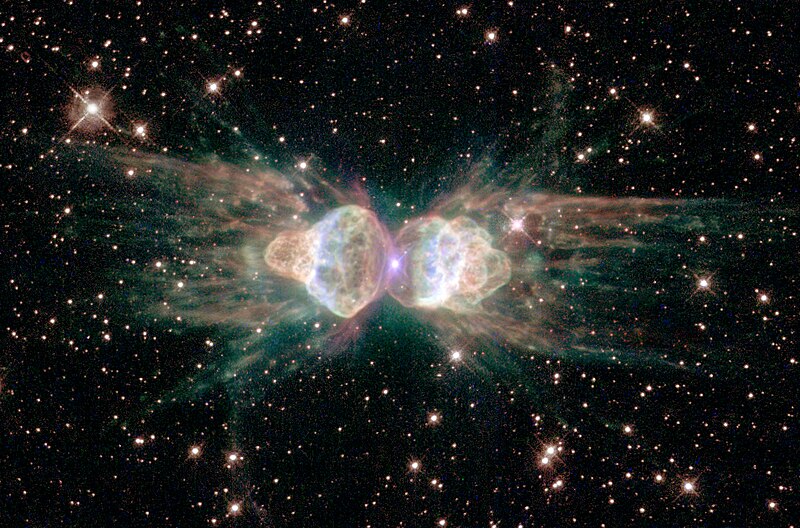
21 Lutetia, so far, is the largest asteroid any human has yet to see up close. This amazing footage, courtesy of National Geographic and the European Space Agency, makes for a great addition to any astronomy class.
11.) They Might Be Giants – Roy G Biv
Off their “Here Comes Science” album – which, incidentally, will crop up on this list multiple times – comes a nifty little ditty about the color spectrum. Of course, it comes with a fun animated music video of its own.

12.) Edible Insects
Cultures all over the world rely on insects to provide protein and other nutrients, and the staff at the National Museum of Natural History share their thoughts on trying a food considered “gross” in Western society.
13.) Giant Double Rainbow
Discovery News sheds some light on a YouTube video involving an anomalous double rainbow, offering a cool, quick lesson in refraction and spectrum physics.
14.) Mirage 1
Robert Krampf is pretty much the Bob Ross of science, and this warm, accessible video explains the basics of how mirages work.
15.) They Might Be Giants - Speed and Velocity w/ Marty Beller
The Flash has nothing on these 2 enjoyable superheroes, who introduce lessons in the difference between speed and velocity.
16.) Earth-Building Wounds
Scientists are studying the unique geological properties of Iceland in order to better understand how tectonic plates form and shift to permanently change the shape of the planet.
17.) The Wright Brothers Discover Aspect Ratio
John D. Anderson at the National Air and Space Museum provides an interesting talk on the Wright Brothers and their indispensible contributions to the history of human flight.
18.) Through the Wormhole: DNA
Morgan Freeman(!!!!!!) narrates a brief clip on the structure and importance of DNA. Short, but soothing. Also educational. Also Morgan Freeman.
19.) Extraordinary Gorilla Encounter Explained
Learn about the reality behind Damian Aspinall’s re-introduction to a gorilla he raised 5 years prior – an interesting glimpse into primate behavior!
20.) Microwaving the World
More sensitive classes may not like thinking about the negative impact an aging sun would have on the planet, but this video still has plenty to offer science teachers whose lessons involve the lifecycles of stars.
21.) Electric Car – They Might Be Giants w/ Robin Goldwasser
Students learning about ecology and alternative energy may appreciate another wonderful installment in They Might Be Giants’s “Here Comes Science” song and video series!
22.) What Do Visitors Really Know About Evolution?
This 1-hour lecture from the National Museum of Natural History shares some of the institution’s findings
regarding how to best educate visitors on the Theory of Evolution.

23.) Robot Controlled by Human Brainwaves
AAAAAAAAAAAAAAAAAAAAAAHHHHHHHHHHHHHHHHH!!!!!!!!!!!
24.) A Color You Can’t See
The infinitely huggable Robert Krampf explains that some colors exist outside of human perception, but cell phone cameras can help individuals see them in action.
25.) They Might Be Giants – Why Does the Sun Shine? (The Sun is a Mass of Incandescent Gas)
One of They Might Be Giants’s most famous songs just happens to have an application in the science classroom, particularly those involving astronomy.
26.) The Medical Heroin Experiment
Educators who enjoy facilitating civil debates in their science classrooms may like this National Geographic video on the medical heroin controversy as a conversation starter.
27.) NASA Android Testing
In the 1960’s, NASA experimented with android robotics for possible space suit applications. They donated their footage (and the metal man himself) to the National Air and Space Museum to educate the populace on their findings.
28.) What is Synthetic Genomics?
Receive a crash course in how cells work and the field of synthetic genomics that has sprung up around them.
29.) Why is the Sky Blue?
Such a simple question actually has an interesting, complex answer involving spectrum physics!
30.) Big Cats Wild for Calvin Klein Cologne?
This humorous video showcases some very unusually findings by the Wildlife Conservation Society regarding how cheetahs react to Calvin Klein’s “Obsession for Men.”
31.) King Weed – They Might Be Giants
Throw a couple of suited men into a biology class for a neat musical discussion of evolution and survival of the fittest.
32.) Smithsonian geologist puts Eyjafjallajökull eruption in perspective
Energetic geologist Liz Cottrell analyzes a particularly infamous volcanic eruption and illustrates what it means for the planet’s structure.
33.) Ticks: Bloodsucking Ninjas of Summer
This useful video talks ticks, both their biology, the diseases they carry and how to prevent a negative encounter with these little Nasty Nellies.
34.) Making Butter
One of the first science experiments most children undertake in their educations involves turning cream into butter, deliciously illustrating different states of matter.
35.) They Might Be Giants – Computer Assisted Design
Listen to a neat song and watch a great animation on what technology can do to help mankind channel its creativity and solve serious problems.
36.) Amazing Northern Lights
Marvel at one of the most breathtaking meteorological occurrences, where lights in every color of the rainbow dance across the sky in smooth, elegant waves.
37.) Apollo 11 TV Broadcast – Neil Armstrong First Step on Moon
Watch one of the most triumphant moments in human history as Neil Armstrong becomes the first man to set foot on Earth’s moon.
38.) Sci Fi Science: Traveling at Warp Speed
Believe it or not, 1 mathematical equation may unlock the reality behind the currently fictitious concept of traveling through space and time without violating any known laws of physics.
39.) Cuttlefish: Chameleons of the Sea
The intelligent, gentle cuttlefish possesses the amazing ability to change both its color and its texture to fit the environment in which it feeds.
40.) Electromagnetic Sun Storms
Although the likelihood of such a deadly cavalcade of electromagnetism is minimal, the sun still holds the potential to wipe out human infrastructure with a particularly heavy burst.
41.) Photosynthesis – They Might Be Giants
Introduce classes to the fundamentals of photosynthesis with another delightful video by They Might Be Giants.
42.) Recreating Volcanoes in a Lab
Follow Liz Cottrell as she shows off the equipment she uses to study volcanoes without ever even leaving her lab.
43.) Sea Otter Poop May Help Save Species
Perfect for ecology and biology classes, this hopeful little video full of spunky l’il otters, information on nurturing their population growth and – of course – plenty of doo-doo.
44.) The Science of Balance
Robert Krampf talks about the relationship between gravity and balance, with plenty of simple, effective demonstrations to prove his point.
45.) I Am a Paleontologist – They Might Be Giants w/Danny Weinkauf
This video wraps up 3 things kids love into one catchy package – dinosaurs, music and not having to stare slack-jawed and disengaged during a lecture.

46.) Dropping 2 Million Pounds
Human engineering and construction has evolved to the point it can pick up a bridge weighing 2 million pounds and (very carefully!) haul it to a new location.
47.) Primordial Soup With Julia Child
The amazing, incomparable Julia Child lends her cooking skills to science education, mixing up a hearty brew of amino acids and discussing how integral they are to all life on Earth.
48.) Popular Science’s Future Of: Pleasure
One fun, enjoyable little robot has been programmed to improvise music and work with humans to improve their talents together and create some amazing songs.
49.) Smart Tech Measures Personal Water Consumption
Hydrosense, developed by the University of Washington, allows individuals to track how much water they use in a day – a useful little device for the ecologically-minded! Perhaps the ecologically-minded classroom?
50.) Twin Super Powers
The Hogans, a pair of twins joined at the cranium, possess an amazing cognitive and sensory ability to see and understand stimuli simultaneously – even if only one of the kids actually sees it.
51.) Solid Liquid Gas – They Might Be Giants
Another rocking time with They Might Be Giants, teaching kids the 3 basic forms of matter and how materials transition between them.
52.) Skeletal Growth- Smithsonian National Museum of Natural History in Washington, D.C.
Watch a brief animated video on how the magnificent human skeleton gradually grows from only 1 day old into adulthood.
53.) Star Spits Out Baby Planet
Punch up on astronomy lessons by showing a Discovery News video explaining – in layman’s terms – how debris from a star gradually creates planets.
54.) Static Charges
Experiment with static electricity alongside the lovely Robert Krampf and learn a few lessons about induction along the way.
55.) Brink – Space Junk
Internet celebrities Rhett & Link sing a catchy song about the manmade clutter that floats about the Earth’s orbit.
56.) Monsters of the Deep
The hugest bivalves in existence, the giant clams sit gently on the seafloor and continue to fascinate scientists for reasons other than their generous size.
57.) Let’s Go For A Spin: Lunar Rovers of Apollo and Constellation
Listen to a fascinating lecture on the latest developments in rover technology and the machinery’s importance to advancing humanity’s knowledge of outer space.
58.) The Nerdabout vlog – How to Hack a Wii Remote
Micro-controllers such as the Wii remote provide some very cool, very basic computing lessons.
59.) Is It Possible? Real Life Batman
Daniel Kish has been blind since the age of 13 months, but gets around almost as well as those with sight using flash sonar and echolocation. Really more of a Daredevil than a Batman, he “sees” with his ears by sending out clicks and measuring their echoes in order to form a “picture” of his surroundings.
60.) Dream Car Archaeology
Engineering classrooms – most especially those populated by gearheads – can find both entertainment and education in this cool National Geographic video of a restoration team working on a ’54 Oldsmobile. Considering the vehicle’s age, they have to piece together different clues and use logic and experimentation to find out what will and will not work.
61.) What Is a Shooting Star? – They Might Be Giants
Astronomy students sometimes struggle with the difference between meteors and meteorites, but enough rounds of They Might Be Giants’s catchy vocabulary lesson can set them straight.
62.) Coral Reefs – A Delicate Balance of Life at the National Museum of Natural History
This video offering by NMNH provides educators with some dramatic images of its coral reef exhibit, and the lack of narration makes it a nice backdrop for lectures on ocean life.
63.) Hawaii Volcano Shows Technicolor Lava
One of the most fascinating geological phenomena on the planet comes to life through infrared imaging, and Discovery News uses the available footage to discuss how scientists use the information to predict eruptions.
64.) Feathers
Explore the ins and outs of fabulous feathers, which contain a multitude of marvels beneath their simple surfaces.
65.) Mammals Vs. Dinos- Mammalian Sensory Development
Learn about the ways in which nocturnal behavior contributed to the perpetuation and evolution of different mammalian species.
66.) Nuclear Explosion in the Sky
Contrary to what many believe, explosives do not have to be dropped on a city in order to disrupt life and dismantle infrastructures.
67.) How Things Fly Exhibition – Blended Wing Body
Take a quick peek into NASA’s experiments in blended wing aircraft and learn a little bit about how they may end up increasing the efficiency of aeronautic vehicles.
68.) Visions of the Future: Intelligent Driving
“Computer power doubles every 18 months,” states this video by the Science Channel. Already, scientists are in a place conducive to designing and testing cars capable of driving themselves!
69.) SDO Captures Eruptions on the Sun
Witness dramatic solar activity recorded by SDO and learn about how the surface of the sun constantly changes.
70.) Slicing Up the Bay Bridge
Physics and engineering students curious about the real-world applications of their lessons may appreciate learning about the challenging repairs that construction workers faced when making the Bay Bridge safer.
71.) They Might Be Giants – Cells
As if the band hasn’t already provided a bevy of great songs and videos for science teachers, They Might Be Giants chimes in with a useful lesson on cellular fundamentals.
72.) Lessons from the Panama Oil Spill
Learn what Dr. Jeremy Jackson at the Scripps Center for Oceanography has to say about how humanity should react to horrifying oil spills based on past experiences.
73.) Why is it So Hard to Lose Weight?
This incredibly valuable video discusses biology, evolution, nutrition and anatomy while also teaching the healthiest method of losing weight.
74.) Solar Power
Solar power plants who use mirrors to capture energy provide some great lessons in how light reflection and refraction work.
75.) It’s All Geek to Me – Vinyl to Digital
David Pogue for the New York Times demonstrates how recording studios transfer music from old vinyl albums to digital media so as not to lose any classics.
76.) Extraordinary Adaptation
Dystonia causes sufferers to perpetually flex up to 500 muscles at once, and Jason Dunn opens up about what life is like with “one of the most annoying things you can imagine.”
77.) Apollo and the So-Called Moon-Landing Hoax
National Air and Space Museum’s curator of Space History Dr. Roger Launius dispels some of the conspiracy theories behind the first moon landing.
78.) Space School- Earth
Thus far, Earth has proven one of the most unique planets in the universe…and definitely the Solar System! Learn about the special properties it possesses that allows life to teem on its surface.
79.) Chimps Face Death Like Humans Do
Several studies have conducted research on how chimpanzees deal with the death of their friends and relatives, and the revelations have come as something of a shock.
80.) Why Geography Matters by Google Earth
Geography encompasses a wide array of subjects, and kids participating in the 2010 National Geographic Bee explain why they believe it’s so important to study.
81.) My Brother the Ape – They Might Be Giants
Teachers allowed to discuss evolution in their classrooms can play this They Might Be Giants video to illustrate the interconnectivity of different animals – including humans!
82.) Science with an Artistic Flair at the Smithsonian’s National Museum of Natural History
Enjoy some of the impressive portfolios from NMNH’s scientific illustrators, who merge the technical with the creative on a daily basis. To incredible results, no less!
83.) Stressed Veggies Better For You
Learn about the biological phenomena that cause cut vegetables to yield greater nutrients – useful lessons for a couple of different scientific disciplines!

84.) Pictures in Silver
The dying art of film photography seamlessly blends art with chemistry, and Robert Krampf shares a characteristically chill experiment explaining how the process works.
85.) The Physics of Baseball – Pitching
America’s allegedly favorite pastime possesses myriad opportunities for teachers to illustrate some of the basic principles of physics.
86.) Alpaca Fleece to Help in Gulf Oil Spill?
Ecology, geography, geology and biology converge in this interesting glimpse at how 4 alpacas at the Alabama Gulf Coast Zoo are contributing to cleaning up the 2010 BP oil spill – a handy lesson that transcends time and date.
87.) Big Blue Sky: The History of Hang Gliding
Physics and engineering classes may enjoy hearing some parts of Bill Liscomb’s neat lecture on the history of hang gliding.
88.) Beyond Tomorrow- Mercedes Brakes
The sleek, sexy Mercedes possesses some advanced technology capable of helping drivers use their breaks more efficiently and safely.
89.) LHC Collides at Record Speeds
CERN’s undeniably ambitious Large Hadron Collider may change the face of particle physics and its associated fields forever, and Discovery Channel provides a quick overview of what scientists hope it will accomplish.
90.) Frog Jumps Caught in Slow Motion
Watch some amazing high-speed footage of frogs jumping in order to learn more about how their complex little bodies work.
91.) They Might Be Giants – The Bloodmobile
They Might Be Giants use their prodigious musical talents to sing about how the circulatory system interacts with other organs to keep a body running smoothly.
92.) Oxygen
Styled like a PSA from the ‘50s, this fun animated video by the National Museum of Natural History teaches viewers how fundamental this element is to the survival of life on Earth.
93.) Synthetic Life Becomes Reality
The J. Craig Venter Institute has developed a revolutionary procedure that will change the face of biology and biotechnology forever – a fully-functioning cell constructed entirely of synthetic DNA.
94.) The Waterfall Effect
Waterfalls provide an extremely interesting opportunity to learn about the relationship between perception and cognition.
95.) Heavy Metal Task Force: Ice Hammer
Ice hammers are amazing machines that allow humans to keep water sources from freezing over too much. These feats of engineering involve incredibly dangerous maneuvers and require the most precise science available.
96.) Understanding Earthquakes
Subterranean events comprise the vast majority of Earth’s activity, and this video explains the science behind one of the most common (and devastating) effects they have on the crust.
97.) Space Shuttle STS-129 Astronauts Visit the Museum
The National Air and Space Museum presents a 1-hour lecture and Q&A session with the 4 astronauts who traveled to the International Space Station on the STS-129.
98.) Physics of Superheroes 1 – Death of Gwen Stacy
University of Minnesota physics professor Dr. James Kakalios presents a very cool series of lectures – all of which are available on YouTube – on the real-life science behind many comic book stories and characters.
99.) Is It Possible?- Personal Jet Pack
Although still in the testing phase, engineering has begun fulfilling some of the promises Hanna-Barbera made with The Jetsons.
100.) They Might Be Giants – Put It to the Test
Marvel as little 8-bit men sing viewers through the different steps of the scientific method.
Videos make for an amazing way to add interest to a lecture and encourage students to better understand the concepts and applications of the sciences. Consider punching up a lesson by infusing multimedia into the classroom, opening up the minds of children and adults alike and allowing them to comprehend the complex ways that the universe works.
Simple K-12 Teaching Community and the Teaching Channel
https://www.teachingchannel.org/ the Teaching Channel
FREE- Great, short videos on a myriad of topics in real classrooms! Tons of resources and teaching ideas!
http://community.simplek12.com/scripts/student/webinars/
A great community that offers free webinars and for a small fee access to the full sight with certificates of completion for the webinars and tons and tons of resources!
Here are some tips I just got today in an hour:
Mobile Apps-
Google Keep- a note taking app
Movie Studio- an android mobile video creation app similar to iMovie
Molecules- an app to rotate 3D space filling molecules
Show Me- create brief screencasts from phone
Leaf snap- take picture of leaf or flower and get information on it
Good resources:
http://www.iear.org/ Review of education apps
http://android4schools.com/ Android Apps for schools
http://educationambassador.com/ Sponsored by Sony
FREE- Great, short videos on a myriad of topics in real classrooms! Tons of resources and teaching ideas!
http://community.simplek12.com/scripts/student/webinars/
A great community that offers free webinars and for a small fee access to the full sight with certificates of completion for the webinars and tons and tons of resources!
Here are some tips I just got today in an hour:
Mobile Apps-
Google Keep- a note taking app
Movie Studio- an android mobile video creation app similar to iMovie
Molecules- an app to rotate 3D space filling molecules
Show Me- create brief screencasts from phone
Leaf snap- take picture of leaf or flower and get information on it
Good resources:
http://www.iear.org/ Review of education apps
http://android4schools.com/ Android Apps for schools
http://educationambassador.com/ Sponsored by Sony
Thursday, August 1, 2013
Boulder Lifestyle article
http://www.boulderlifestylepubs.com/monarchs-kristin-donley-and-her-high-tech-classroom/
 Words Sheila Lucas
Monarch’s Kristin Donley and her High-Tech Classroom
 Words Sheila Lucas
Monarch High students are making history through their immersion in an innovative STEM (Science/ Technology/Engineering/Math) Pilot Project within Monarch High’s Biology Department.
Leadership on the ongoing biology research project, which uses 3D video simulations to bring biology to life, is provided by Monarch’s Kristin Donley, AP Biology Teacher and Adjunct Professor at CU Denver. Donley was honored by the State of Colorado Department of Education as the recipient of the 2012 Colorado Teacher of the Year Award (as well as 2011 Technology Teacher of the Year).
Her students have increased their test scores and understanding of challenging AP Biology concepts during the last three years of the project. Donley enjoys being able to take the unique Designmate 3D video simulations into many classrooms throughout Boulder Valley Schools to enhance student learning and outcomes.
“I really like the way that the Stereoscopic 3D software makes learning more interesting and visual,” says Monarch AP Biology student Kevin Holt. “It also enhances clarity on abstract ideas and brings learning to life.”
According to industry leaders from Change the Equation, the CEO- led initiative to improve STEM studies, “STEM is the future. STEM learning is an economic imperative. Experts concur that technological innovation accounted for almost half of U.S. economic growth over the past 50 years, and most of the 30 fastest-growing occupations in the next decade will require at least some background in STEM.”
Over her thirteen years at Monarch (and a total of seventeen years in the Boulder Valley District), Donley has consistently delivered outstanding leadership, inspiring students to succeed in vital science and computer technology achievements. She brings her special talents to the afterschool Technology Student Association, whose members took two top prizes at this year’s state competition in creative and innovative submittals.
Students at Monarch also benefit from dual credit programs that Donley has directed for years to facilitate the students’ access to earning credits in courses at CU Boulder, while still in high school.
This STEM Pilot Project in 3D technology has helped Donley’s students improve their essay test scores and motivation, as well as become more engaged in developing critical thinking skills so vital to their success in today’s Global Knowledge Economy.
According to Donley, “The Designmate.com 3D software has pro- vided equity for all learners and has proven that it has even helped students with learning challenges to visualize and better understand abstract curriculum that they previously had trouble with. My students have acknowledged that they are able to remember the video images, which helps them retain knowledge longer and improve their test scores and overall grade.”
The students and Donley are excited to acknowledge the support of the sponsors who have provided the first phase of funding to enable the project to continue into the 2013-2014 year:
Ed Dobbs and Fallon Price of Flatirons Landrover are committed to providing support for Monarch to continue to grow a strong STEM program that prepares students for the intense math, science and engineering demands of the future workplace.
Boulder Valley Credit Union has supported lifelong learning events and programs within the Boulder Valley School District since 1959. The credit union is proud to sponsor and support the STEM Pilot initiative that can expand classroom learning and enhance knowledge retention.
Isidro Gonzalez of Old Santa Fe Mexican Grille is a long-time supporter of the athletic teams at Monarch who generously supports this project as well.
Designmate.com has graciously provided the licenses to the software for the past three years at no cost to the school and enjoys major success in educational institutions throughout Asia, Brazil and the Middle East.
Dave and Sheila Lucas of NxGenLearning.net provide the technical support and fund-raising liaison efforts and offer their expertise as leading consultants/trainers to schools seeking to implement effective Stereo 3D Classroom solutions.
For those in the community who wish to learn more about upcoming op- portunities to attend hands-on experiences of this 3D Classroom of the Future, and to learn more about how our students are closing the “global achievement gap,” please contact Sheila Lucas at 303.989.1767 (Sheila@ NxGenLearning.net) for upcoming dates and locations.
Monday, July 8, 2013
Global Fellows Brazil (Brasil) Trip- Perspectives
Philanthropy and global education are important endeavors
that have the potential to positively change the world. The Pearson Foundation, the National
Education Association Foundation and EF have co-founded a program called the Global
Learning Fellowship. The mission of the
Global Learning Fellowship is to provide educators with the knowledge, expertise
and disposition needed to teach in a culturally diverse world. Through participation in the fellowship,
educators become global leaders acquiring the skills necessary to integrate
global instruction into their classrooms and districts. The objective of this program is to create
global competency through a summer exchange program. Educators who participate
in the program have traveled to China and Brazil, learning about the cultural
and societal impacts that affect both countries’ educational systems.
Global competence means that a citizen has the knowledge,
skills and dispositions to act creatively and effectively on solving issues of
global significance, such as reducing poverty, disease, wars and climate
change. In order to be globally competent and economically competitive,
citizens need to be innovative entrepreneurs.
The ability to be adaptive, respond to change and to creatively problem
solve are key traits of a 21st century learner. These traits are also critical in creating
innovative entrepreneurs and global competitiveness. The Global Learning Fellowship provides
educators with an opportunity to expand their horizons, immersing them in a
cultural experience that transforms their world view. Additionally, through the
participation in continuous professional learning groups, educators work
collaboratively to develop integrated, global lessons that stress critical
thinking skills and creativity. It is
through this collaboration that educators can advance their pedagogical
practices, and, thus, contribute to the closing of the achievement gap.
Much research demonstrates that educators that focus on route
memorization of facts and teach primarily for success on state tests have
unmotivated, low performing students.
Conversely, educators that focus on critical thinking skills and creative
problem solving tend to have students who are more motivated to learn and are higher
achieving. Educators who teach to levels
that are higher on Bloom’s taxonomy create students who are more adaptable and
can transfer knowledge from one situation to another. The Global Learning Fellowship trains
educators to create transformative lessons that espouse the highest of Bloom’s
taxonomies—evaluation and synthesis. Students who are taught in a
transformative manner are able to analyze information and support it with
evidence in a creative and original way.
Conversely, students who are not taught in a transformative manner, may
only be able to regurgitate information, and, not wholly understand its
meaning. Additionally, educators know
that in order for students to evaluate and synthesize information, they need to
have some relationship to the content.
Students are not motivated by content; they are motivated by
the characteristics that a particular assignment calls on them to accomplish. The
Global Learning Fellowship provides a context for educators to create meaning
and application for their students. For
example, a Global Fellow educator can study how climate change has affected the
economy and culture of Brazil, and, then create several lessons that relate
those learnings to the American economy and culture. Consequently, the educator has created a
transformative lesson in which students are evaluating and synthesizing,
looking for global relationships. The educator is helping students become
motivated to learn and understand the world in which they live, thereby,
promoting global competency.
The power of the Global Fellowship is that it helps ensure
that educators are inspired to bring back what they have learned to their
students and district. The program
values global equity by promoting dialog between people of different cultural
backgrounds. Educators from all fifty
states travel together to a foreign country.
They develop a powerful relationship as they explore and reflect upon
their own prejudices and preconceptions.
They forge bonds with educators across the globe, developing critical
friends that energize and motivate their students to want to learn.
It has been said that the business of schools is to create
engaging learning experiences that promote workforce ready students. The Global Fellowship program is an
organization that makes the world a better place to live. This organization achieves this through its
generous support of educators around the world.
The sponsors of the program have created a website with outstanding
resources that support educators in their pursuit of global competency. By
providing experiences as those described, the program not only transforms the
lives of educators, but also the lives of the educator’s students. These students may never get the chance to
travel outside of their small communities; however, the Global Fellowship
program connects these students to other cultures by promoting global
competency in their teachers.
I personally had the privileged opportunity to travel to Brazil--Sao Paulo and Rio de Janiero to tour schools and learn as much as I could about the Brazilian culture. I have come back a changed person. I have learned that the world is much more inter-connected. The biggest take-home was that we all desire to build meaningful relationships-- to know that an appreciation of the power of education can create opportunities and transform the world into a better place for all! Below is a slideshow glimpse of this powerful experience that the NEA Foundation and Pearson provide...Thank you to my new Global Friends!
For more information, visit: http://www.neafoundation.org/pages/nea-pearson-foundation-global-learning-fellowship/
See more blogs from Brasil- http://www.neafoundation.org/blog/
See more blogs from Brasil- http://www.neafoundation.org/blog/
Thursday, May 30, 2013
Blog Article from Josh Stumpenhorst
This is a blog from Josh Stumpenhorst, the 2012 Illinois Teacher of the Year!
http://www.nnstoy.org/josh-stumpenhorst-21st-century-educator/
What do you think?
http://www.nnstoy.org/josh-stumpenhorst-21st-century-educator/
What do you think?
Saturday, April 20, 2013
3D in Education
So I recently was highlighted in two cool blogs:
1. http://www.display-central.com/free-news/brain-research-and-3d-in-education/ Thanks Len!
2. http://www.indeptheducation.com/wp/indeptheducation-coms-3d-educator-of-the-month-kristin-donley/ Thanks Nancye!
What are your thoughts about 3D in education? It seems American schools are behind other schools globally when it comes to the use of 3D in education. I have some thoughts as to why... 1. American schools are stuck in "tradition" and it seems anything new is hard to move those who are in charge of making the decisions, 2. 3D is expensive and with tight budgets, it is seen as an extravagance, 3. People don't understand its value in education...it is still seen as a "hollywood" technology, and 4. American School reform is caught up in this idea of running schools as if they were a business...streamlining education and stamping out individual educator innovation. I have worked in the public school system for 20 years and frankly it is hard to get support for creating a 21st century classroom for all students. We all agree it should happen, but when push comes to shove, nothing happens. So, I and many other cutting-edge innovators plug along alone.... If you are an innovator, please respond to this blog and let me know how we can make our dreams a reality!
1. http://www.display-central.com/free-news/brain-research-and-3d-in-education/ Thanks Len!
2. http://www.indeptheducation.com/wp/indeptheducation-coms-3d-educator-of-the-month-kristin-donley/ Thanks Nancye!
What are your thoughts about 3D in education? It seems American schools are behind other schools globally when it comes to the use of 3D in education. I have some thoughts as to why... 1. American schools are stuck in "tradition" and it seems anything new is hard to move those who are in charge of making the decisions, 2. 3D is expensive and with tight budgets, it is seen as an extravagance, 3. People don't understand its value in education...it is still seen as a "hollywood" technology, and 4. American School reform is caught up in this idea of running schools as if they were a business...streamlining education and stamping out individual educator innovation. I have worked in the public school system for 20 years and frankly it is hard to get support for creating a 21st century classroom for all students. We all agree it should happen, but when push comes to shove, nothing happens. So, I and many other cutting-edge innovators plug along alone.... If you are an innovator, please respond to this blog and let me know how we can make our dreams a reality!
Tuesday, December 11, 2012
Teacher/Administrator Effectiveness and Licensure
What are your thoughts about teacher/adminstrator evaluations and licensure?
http://www.ed.gov/teaching/national-conversation
Please share your ideas, thoughts, concerns.....
http://www.ed.gov/teaching/national-conversation
Please share your ideas, thoughts, concerns.....
Monday, December 10, 2012
Blended Learning/Flipped Classrooms Article
http://www.edtechmagazine.com/higher/article/2012/08/colleges-go-proactive-flipped-classrooms
What do you think?
What do you think?
My Web Site
Here is the link to my website-
https://sites.google.com/a/bvsd.org/donleyscience/
Please feel free to take and share resources!
https://sites.google.com/a/bvsd.org/donleyscience/
Please feel free to take and share resources!
Subscribe to:
Posts (Atom)